
About Where’s The Scares?
A horror jump scare database with verified counts, timestamps, and recovery metrics.
4 Lovecraftian Monsters Brought to the Big Screen
Published March 1, 2026
This article may contain affiliate links. As an Amazon Associate we earn from qualifying purchases.
Lovecraftian monsters were never meant to be understood. They are ancient intelligences and cosmic forces that exist beyond human comprehension, entities so vast and indifferent that, to them, humanity barely registers as more than dust in the universe.
Many films borrow Lovecraft’s atmosphere. Far fewer attempt to visualize his creations directly, and even fewer succeed. This list spotlights the rare movies that don’t just hint at the void, but let it stare back. Here are 4 Lovecraftian Monsters Brought to the Big Screen.
Color Out of Space
Color Out of Space (2019)

Color Out of Space opens with a meteorite striking a rural property, introducing an entity that defies classification. It isn’t a traditional creature, but an unseen force that distorts everything it touches, never fully revealing itself.
Lovecraft described the “color” as existing beyond the visible spectrum, imperceptible to the human eye. The film answers that challenge by translating the unseeable into unnatural light that permeates soil, water, plants, and flesh. Crops rot into luminous mutations. Animals fuse together. Bodies warp beneath a glow that does not belong to this world.
The horror is not a creature to confront, but contamination that cannot be contained. There is no negotiation or victory, only inevitability. The film preserves the core Lovecraftian truth: the universe does not attack humanity out of malice. It hurts us without noticing we were there.
The Deep Ones
Dagon (2001)

Dagon tells the story of a shipwreck survivor who takes shelter in a crumbling Spanish fishing village. Its residents are devoted to an ancient sea god, whose influence is etched into every corner of the town.
The film commits to showing the Deep Ones: slitted eyes, gilled necks, slick amphibious skin, and ritual spaces soaked in brine. These are not distant silhouettes or implied horrors. They are a corrupted lineage, born of generations spent too close to something vast beneath the waves, proof that the cosmic does not elevate humanity, it consumes it.
Unlike adaptations that keep the cosmic abstract, Dagon makes that corruption physical. By revealing the race while preserving the mystery of the deity behind them, the film visualizes Lovecraft’s mythos without diminishing its enormity.
Mi-Go
The Whisperer in Darkness (2011)

The Whisperer in Darkness brings the Mi-Go to the screen as extraterrestrial beings operating in rural Vermont. Filmed in black and white, the movie adapts one of Lovecraft’s clearest descriptions of alien life, a rare case of a film committing to detailed depiction rather than suggestion.
Segmented limbs, thin membranous wings, mechanical appendages, and human brains in canisters are on display. These creatures are not symbols of madness or fleeting shapes in shadow. They are clinical, methodical, and indifferent. Humans are not enemies or prey; we are disposable specimens. By showing these creatures, the film accepts the central risk of cosmic horror: that the incomprehensible may lose power if it is understood. Here, the Mi-Go retain their menace because their intelligence and detachment remain beyond human scale, even while their bodies are fully revealed.
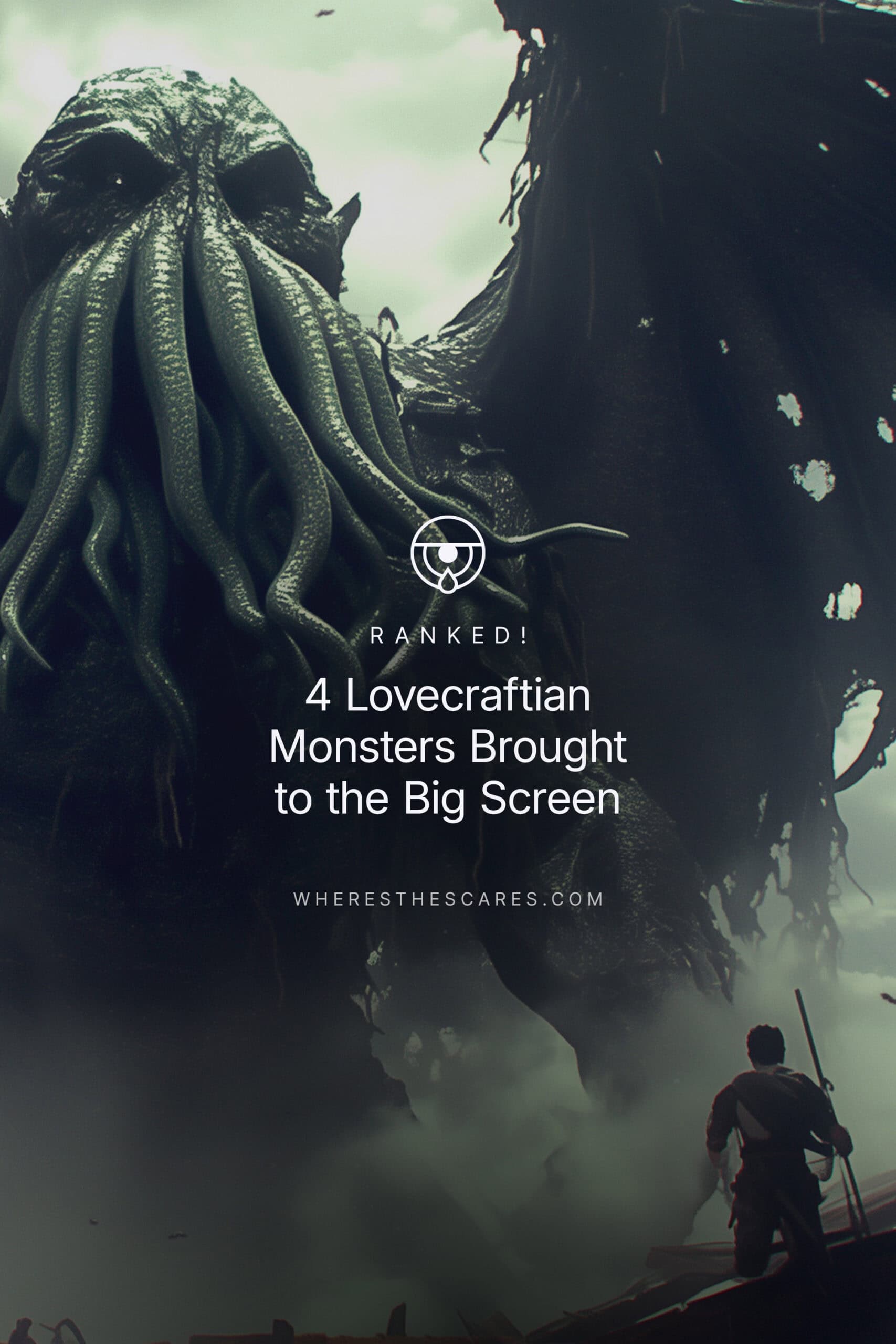
Cthulhu
The Call of Cthulhu (2005)

The Call of Cthulhu adapts Lovecraft’s classic story in a silent-era style with striking black-and-white visuals. The narrative unfolds through fragmented accounts that build toward Cthulhu’s appearance.
When he finally rises from the sea, the film presents him as a towering, tentacled presence dwarfing the ships around him. He is not a monster to defeat. He is a force you endure, or don’t.
In keeping with the film’s vintage aesthetic, Cthulhu is brought to life with an articulated puppet. This practical effect reinforces the period tone and more importantly, helps the film preserve the heart of Lovecraft’s style: it’s not about spectacle and destruction, but the realization that we never mattered to begin with.
Capturing cosmic horror on film is a paradox: how do you show the “unshowable”? These films succeed by bringing Lovecraft’s creations into view without stripping away their mystery, proving that some things can be seen but never truly understood.